Why Are Anime Studios Going Bankrupt During a Record Boom? Studio KAI, Gainax and the "Profitless Boom"
Anime made a record ¥3.84 trillion in 2024, yet studios keep closing for the third year in a row. Here's what happened at Studio KAI, Gainax and Doga Kobo, why the money skips the people who draw the shows, and what I think has to change.
| Category | Anime |
|---|---|
| Published | OCT 21, 2026 |
| Read time | 10 MIN |
Anime studios are going bankrupt during the biggest boom the industry has ever had. Japan's anime market hit a record ¥3.84 trillion (about $25 billion) in 2024, and the research firm Teikoku Databank still expects studio closures to rise for a third year in a row. That gap has a name in Japan, the "profitless boom", and it explains why the studio behind Umamusume: Pretty Derby is deep in the red while the franchise keeps selling.
This article puts the numbers side by side, walks through three cases (Studio KAI, Gainax and Kadokawa's purchase of Doga Kobo), explains the production committee system that decides who gets paid, and ends with my own take.
The Numbers: A Record Market and Rising Closures
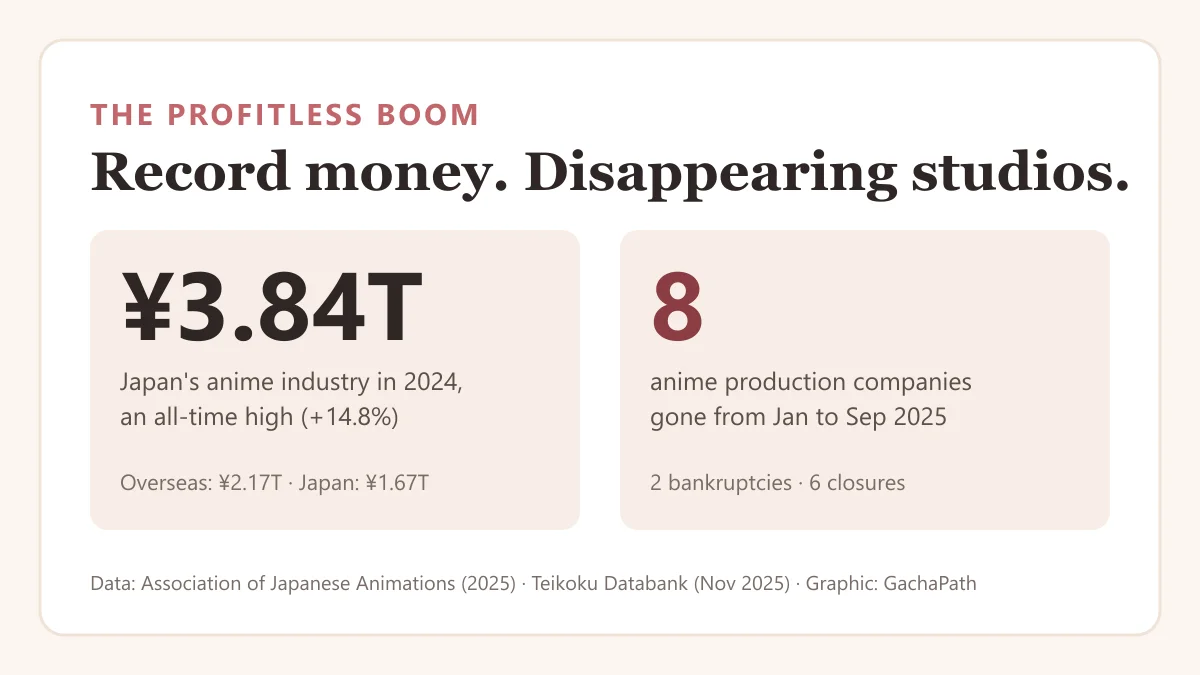
The Association of Japanese Animations (AJA) puts the 2024 anime industry at ¥3,840.7 billion, up 14.8% on 2023 and the highest figure ever recorded. Overseas sales did most of the work: ¥2,170.2 billion from abroad (up 26%) against ¥1,670.5 billion inside Japan (up 2.8%). Anime now earns more outside Japan than at home.
The studio side tells a different story. On November 5, 2025, Teikoku Databank reported that 8 anime production companies left the market between January and September 2025: 2 legal bankruptcies and 6 that suspended business or dissolved. That pace matches 2018, the worst year on record with 16 exits, and puts 2025 on track for the third straight annual increase. In the same report, about 60% of prime contractors (the studios that lead a whole production) said their results for fiscal 2024 had gotten worse.
| Indicator | Figure | Source |
|---|---|---|
| Anime industry market, 2024 | ¥3,840.7 billion (record, +14.8%) | AJA |
| Overseas market, 2024 | ¥2,170.2 billion (+26%) | AJA |
| Domestic market, 2024 | ¥1,670.5 billion (+2.8%) | AJA |
| Production companies that exited, Jan–Sep 2025 | 8 (2 bankruptcies, 6 closures) | Teikoku Databank |
| Record year for exits | 2018, with 16 | Teikoku Databank |
| Prime contractors with worse FY2024 results | About 60% | Teikoku Databank |
These are not only tiny subcontractors. Teikoku Databank says roughly half of the anime production companies that exited over the past five years were prime or "gross" contractors, studios able to make an entire show. Its examples include Ekachi Epilka in Sapporo, Cloud Hearts, whose problems surfaced when Whisper Me a Love Song was delayed, and the 3DCG studio 5 (Five). The most talked-about case of 2026, though, is a studio that has not closed at all.
Studio KAI: Deep in the Red but Still Working
Studio KAI posted a net loss of ¥565 million (about $3.5 million) for the year ending December 2025, according to the financial notice it published in Japan's official gazette on April 13, 2026, as reported by Gamebiz. The loss more than doubled from ¥248 million a year earlier. The notice lists accumulated losses of about ¥2.05 billion against total assets of about ¥1.9 billion, which means the company owes more than it owns.
Many English headlines called this "insolvency" or "bankruptcy". It is neither a bankruptcy filing nor a shutdown. Studio KAI is a subsidiary of the advertising group ADK Emotions, and it is still making anime: it animates The Ramparts of Ice Season 2, which began airing on October 1, 2026. Negative net worth is still a serious warning sign, because the studio needs its parent's support to keep going, and the losses are not new. Studio KAI reported a loss of about ¥400 million for its first fiscal year and ¥165 million for 2020.
What makes the case painful is how Studio KAI worked. It had 133 employees as of December 2025, and Famitsu describes it as a studio that hires animators as full-time staff and keeps a high share of its production in-house instead of outsourcing. That is exactly what critics of the industry ask studios to do.
Studio KAI Anime List
Studio KAI was founded by ADK Emotions in June 2019, and the following month Gonzo transferred part of its production business to it. These are its main TV anime:
| Anime | Premiered |
|---|---|
| Umamusume: Pretty Derby Season 2 | January 2021 |
| Super Cub | April 2021 |
| Skeleton Knight in Another World (with Hornets) | April 2022 |
| The Prince of Tennis II: U-17 World Cup (with M.S.C) | July 2022 |
| Shine Post | July 2022 |
| Fuuto PI | August 2022 |
| Captain Tsubasa: Junior Youth Arc | October 2023 |
| Umamusume: Pretty Derby Season 3 | October 2023 |
| 7th Time Loop: The Villainess Enjoys a Carefree Life Married to Her Worst Enemy! (with Hornets) | January 2024 |
| Hell Teacher Nube | July 2025 |
| A Star Brighter Than the Sun | October 2025 |
| Sentenced to Be a Hero | January 2026 |
| The Ramparts of Ice | April 2026 |
| Snowball Earth | April 2026 |
| Mistress Kanan Is Devilishly Easy | April 2026 |
| The Ramparts of Ice Season 2 | October 2026 |
Studio KAI shows how a well-run, worker-friendly studio can still lose money. Gainax, the next case, shows the other way a studio dies.
Gainax: What a Long Fall Looks Like
Gainax, the studio that made the original Neon Genesis Evangelion TV series, filed for bankruptcy in May 2024 and was formally dissolved in December 2025, according to a statement from Khara, the company of Evangelion director Hideaki Anno. Unlike Studio KAI, Gainax's collapse came mostly from inside.
Khara's account lists the problems. Gainax's finances worsened from around 2012. Debts run up by management got it removed from production committees after it failed to pay royalties, and lawsuits followed, including a ¥100 million suit from Khara in 2016 that a court ordered Gainax to pay in 2017. In December 2019, its representative director was arrested, and Gainax said it lost the ability to operate while still carrying heavy debt. A suit from a debt collection company in May 2024 was the final push into bankruptcy.
Gainax is a warning about management, not a clean example of the profitless boom. The next case involves a company with plenty of money.
Kadokawa and Doga Kobo: When Buying a Hit Studio Doesn't Pay Off
Kadokawa bought Doga Kobo, the studio behind Oshi no Ko, in 2024 for nearly ¥3 billion. On November 6, 2025, it booked a ¥2.7 billion goodwill impairment on that purchase as an extraordinary loss and cut its full-year forecast.
A write-down does not mean Doga Kobo lost ¥2.7 billion. It means Kadokawa now values the studio far below the premium it paid, because the profits it expected did not show up. Kadokawa told investors the impairment "does not indicate any concerns about the future" of its studio business. Still, a publisher with hit IP bought one of the most popular studios in the business and could not make the numbers work. To see why, you have to look at how anime is paid for.
Why It Happens: The Production Committee Model
Most TV anime is funded by a production committee, a group of companies such as publishers, music labels, merchandise makers, broadcasters and streaming partners. Each member invests money and gets a share of the rights in return. The committee then pays an animation studio a fee to make the show.
That fee is the problem. A studio that is only hired to animate usually gets a set production fee, and the long-term income from streaming licenses, Blu-rays, music, merchandise and overseas sales goes to the committee members according to their investment. A studio can join the committee, but only if it has cash to invest, and most small and mid-size studios don't. So when a show becomes a global hit, the studio that drew it often sees little or none of the extra money.
Teikoku Databank adds the cost side. Its report describes studios that are "busy without profits":
- Too many shows, too few people. The number of titles grew faster than the workforce, so studios take on more orders than they can handle.
- Longer schedules, higher labor costs. Delays stretch productions, and every extra month is paid by the studio.
- Outsourcing got expensive. Studios that send work abroad pay in dollars while earning in yen, and the weak yen made that far more costly.
- Burnout in the fix-up work. Industry people told the report that cheap overseas work often needs heavy correction in Japan, which wears out experienced key animation directors and pushes them to quit.
- No IP income to fall back on. Studios without rights income of their own are hit hardest when costs rise faster than fees.
Put together, a studio can be fully booked for years and still lose money on every show. A few studios have tried to break out of that trap.
Is Anyone Breaking the Pattern? MAPPA's Chainsaw Man Bet
MAPPA paid for 100% of the Chainsaw Man TV anime itself, with no production committee, which is rare in the industry. That gave the studio control of the rights, promotion, merchandise and overseas sales. MAPPA president Manabu Otsuka later wrote that the responsibility was far heavier than the studio had expected and that the first season did not go entirely as planned. The bet paid off over time: Chainsaw Man – The Movie: Reze Arc became MAPPA's next ¥10 billion box office hit after Jujutsu Kaisen 0, according to Otsuka's account.
The catch is that self-funding needs money most studios don't have. MAPPA could take the risk because of earlier hits. For a studio like Studio KAI, that path is closed unless the people who fund anime change the rules.
Kairo's Take
An industry where the creators go bankrupt while their creations set revenue records is fundamentally unsustainable. The committee system was built to spread risk for domestic TV, and it's outdated for a global streaming era. Studios should get revenue-sharing clauses or equity stakes in the IP they create, and streaming services with real leverage like Netflix, Crunchyroll and Disney should order directly from studios with profit-sharing and realistic production timelines. Studios also have to stop accepting fixed-budget contracts that guarantee a loss the moment a schedule slips. Seeing the studio behind Umamusume sink into the red while the franchise prints money says everything about who this system really works for.
Frequently Asked Questions About Anime Studio Bankruptcies
Why are anime studios going bankrupt?
Most studios are paid a fixed fee by a production committee, while costs keep rising because of staff shortages, longer schedules and expensive outsourcing. The income from a hit mostly goes to committee members, so studios can be busy and still lose money.
Did Studio KAI go bankrupt?
No. Studio KAI reported a ¥565 million net loss for 2025 and owes more than it owns, but it has not filed for bankruptcy. It is still operating as a subsidiary of ADK Emotions and animates The Ramparts of Ice Season 2, which began in October 2026.
Is the anime industry in decline?
Not in sales. The Association of Japanese Animations valued the industry at a record ¥3.84 trillion in 2024, up 14.8%. The trouble is on the production side, where studios struggle to turn that demand into profit.
Is the animation industry collapsing?
Japan's anime business is growing, but its production base is under strain. Teikoku Databank expects studio closures to rise for a third straight year, and about 60% of prime contractors reported worse results for fiscal 2024.
Do anime studios make money?
Some do, but many don't. A studio hired only to animate usually earns a set fee, so its profit depends on finishing on budget. Studios that invest in the production committee or own the IP, like MAPPA with Chainsaw Man, can also share in a hit's later income.
How do anime production committees work?
Companies such as publishers, music labels, broadcasters and merchandise makers fund an anime together. Each member gets a share of the rights and profits based on its investment, and the committee pays an animation studio to make the show.
How much is the anime industry worth?
The Association of Japanese Animations valued it at a record ¥3.84 trillion in 2024, about $25 billion. More than half of that, ¥2.17 trillion, came from overseas.
For more on the studios named here, see our guides to Sentenced to Be a Hero, Hell Teacher Nube and Oshi no Ko season 3, browse the Fall 2026 anime schedule, or catch up on the latest anime news.
Sources: Association of Japanese Animations (2024 market figures), Teikoku Databank (closures report, November 5, 2025), Gamebiz (Studio KAI financial notice), Automaton (Studio KAI staff and production model), Anime News Network (Studio KAI's 2020 loss), Wikipedia (Studio KAI works list),Anime News Network (Gainax, from Khara's statement), Animenomics (Kadokawa filing), Automaton (MAPPA and Chainsaw Man). Graphic by GachaPath from AJA and Teikoku Databank data. Cover photo: Ryo FUKAsawa, CC BY 2.0, via Wikimedia Commons, cropped. Yen-to-dollar conversions are approximate.
Anime and manga fan writing honest reviews and industry news — one person, real opinions, no ghostwriting.